

Lesson Plans: Developing Media Literacy Skills
Lesson plans give students a chance to explore media literacy through activities and discussions. Students can work with real life examples of online information, share their ideas, and discuss how messages are created and presented. These lessons help students practice questioning information and applying media literacy skills to situations they may come across online.
RESOURCE 2: LESSON PLAN
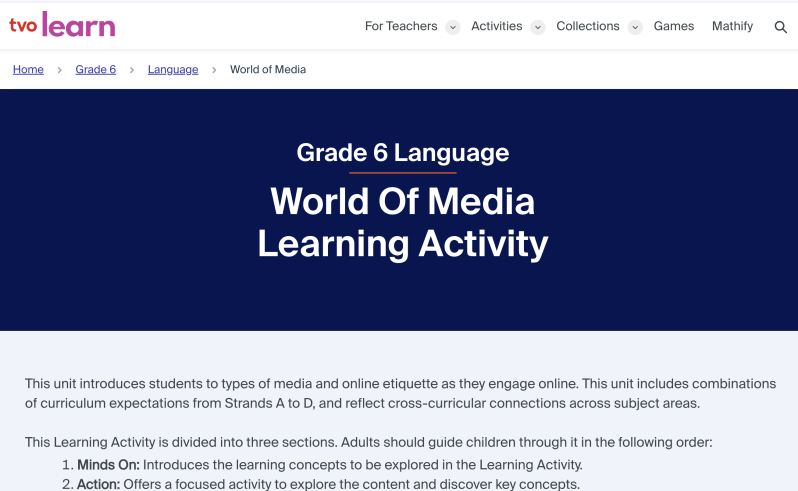
Grade 6 Language - World of Media is a lesson that introduces students to different types of media and how they are used. Students explore different forms of media they come across in their everyday lives and classify them based on their purpose and characteristics. The lesson also gets students thinking about how media can influence the way people understand information and communicate with others. Through these activities, students build a better understanding of the different types of media around them and how media can shape the way information is shared and understood.
CULTURALLY RESPONSIVE PRACTICE

This lesson supports culturally responsive teaching by starting with the media students already use in their everyday lives and at home, making their experiences part of the learning. It also connects to the idea of cultural competence, as students can bring their own languages, experiences, and media practices into the discussion while developing academic skills (Ladson‐Billings, 1995).
CROSS-CURRICULAR CONNECTIONS

- Social Studies: Strand B2 - Students can compare how different media present the same event or community, and consider whose voices are included or left out.
- Visual Arts: Strand D2 - Students can create their own poster or advertisement and explain how their choices of images, colour, and words are meant to influence an audience.
MULTILITERACIES FRAMEWORK

- Multimodality: This lesson explores media that combine text, images, sound, and discuss how each tool helps shape the message
- Experiencing: Students begin with media they use in their everyday lives, such as apps, shows, and games, and share their experiences with them.
- Conceptualizing: Students sort different types of media based on their purpose, features, and identify what makes each type different.
- Applying: Students use what they have learned in a new situation, such as thinking about how the same message could be shared through a different type of media.
CRITICAL MEDIA LITERACY

This lesson helps students build media literacy skills by identifying and sorting different types of media based on their purpose and features. It also gets students thinking about the media they use every day and how it can shape the way they understand information and communicate with others.
CURRICULUM CONNECTIONS

- A2.2 – Online Safety, Well-Being, and Etiquette: Students think about the different types of media they use and how to interact with media safely and responsibly.
- A2.3 – Gather, Evaluate, and Use Information: Students explore different types of media and consider their purpose, audience, and how information is presented.
- A2.4 – Forms, Conventions, and Techniques: Students examine how different media forms use features such as text, images, sound, and video to communicate a message.

EXTRA RESOURCES....


Create Your Own Website With Webador